


Tile Hole Master
PineappleGame
Tile Hole Master is the kind of arcade puzzle game I can open for a short break without needing to remember a complicated story, build a character, or learn a long list of controls. Its central idea is simple: I move a hole around a three-dimensional board, swallow tiles, and work toward clearing the arrangement. That single interaction gives the game its identity, but it also determines whether you will enjoy it. If you like visual sorting challenges with immediate controls, PineappleGame’s title is easy to understand within moments. If you want deep strategy, a campaign with substantial narrative, or a competitive arcade experience, its focused design may feel limited.
I tested it with the expectations I normally bring to casual mobile puzzles, and the most important thing I noticed was how much the hole changes the way I read a board. I am not merely matching identical pieces or tapping the correct answer. I have to look at the space around the opening, judge which tiles can be reached, and decide whether swallowing one group will make the next route easier or more awkward. The board is presented as a themed 3D puzzle, so position matters more than it would in a flat tile-matching game.
Why the moving hole is the whole experience
The moving hole is not just a visual gimmick. It turns a familiar clearing task into a problem of access and order. A tile may look close, but the route toward it can be blocked by other pieces. I found myself thinking one move ahead, especially when a board became crowded. The useful question is often not “Which tile should disappear first?” but “Which tile can I remove now so the rest of the board becomes readable?” That small change in perspective gives the game more thoughtfulness than its one-line premise suggests.
In practice, this capability creates a nice middle ground between a reflex game and a traditional puzzle. The arcade side comes from moving the hole directly and reacting to the changing board. The puzzle side comes from planning a clean sequence instead of wandering randomly. I liked that the action remains understandable even when the board becomes visually busy: the hole is the active object, the tiles are the targets, and the goal is to leave the board clear.
The best part is the way movement and decision-making are tied together. Every swipe or directional adjustment has a practical consequence. A careless move can place the hole in an unhelpful position, while a deliberate route can open several options at once. That makes the game more satisfying than a simple “move over everything” activity, even though the basic objective remains very accessible.
Related News






Themed boards also help the experience avoid looking like an abstract grid. Shapes and colors give me visual landmarks, which is useful when I need to remember what I have already cleared and what still needs attention. At the same time, decoration can make a board harder to scan. When several pieces look similar or overlap from the camera angle, I have to slow down rather than trust my first impression. That is not necessarily a flaw, but it means the game rewards careful observation as much as quick fingers.
What a normal play session feels like
I usually approach a board in three passes. First, I look at the overall arrangement and identify the most open area. Second, I move the hole through the easiest reachable tiles rather than immediately chasing a distant target. Third, I reassess the board after the first clear section, because the useful route often changes once space has opened. This method is more reliable than trying to follow a fixed path from the start.
That workflow is one of the more useful discoveries in the game. The board should be treated as something that changes after every successful sequence. If I focus only on the next tile, I can end up in a corner with fewer choices. If I clear from the outside inward, I generally get a better view of the remaining arrangement. I would not call this a formal strategy system, but it is a practical habit that makes the puzzles feel less random and reduces unnecessary movement.
Gallery
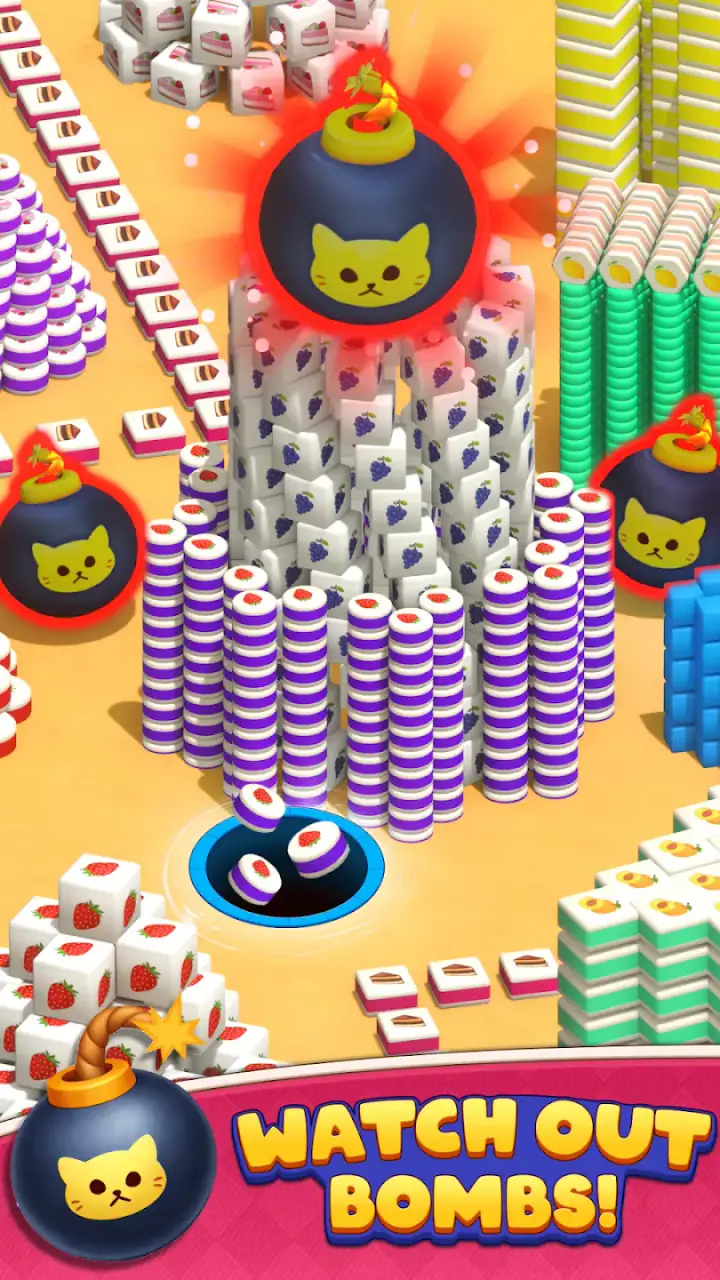
Another tip is to pause mentally before entering a narrow section. The hole’s position affects what I can reach next, so rushing toward a tempting cluster can create extra work. I found that a short scan of the nearby tiles was often more valuable than moving immediately. This is especially helpful for players who are comfortable with arcade controls but tend to make decisions too quickly in spatial puzzles.
The controls are easy enough for a first-time player to understand, which is important for a game built around one central action. I did not need a tutorial-heavy introduction to grasp the objective. The challenge comes from applying the movement well, not from learning a complicated interface. That makes it suitable for a quick session while still leaving room for improvement as I become better at reading the board.
A realistic everyday use case
I can see myself playing Tile Hole Master while waiting for a coffee, sitting on public transport, or taking a short break between tasks. A board gives me a contained problem: I can focus on the route, clear the arrangement, and put the phone away without having to remember a large amount of context. This is where the game’s narrow concept works in its favor. It does not ask me to manage a long-term collection or maintain a complicated routine before the basic activity becomes enjoyable.
It is also a reasonable choice for someone who wants a low-pressure game with a little more thinking than a typical endless tapper. The action is visually direct, but the best results come from patience. I would hand it to a friend who enjoys sorting objects, clearing spaces, and finding an efficient path through a compact puzzle. I would not recommend it as strongly to someone who needs constant novelty, story progression, or a large variety of game modes to stay interested.
Because the game is free to download, it is easy to try without committing money at the beginning. The free entry point is useful here because the concept is very specific: you will know quickly whether moving a hole around 3D boards feels satisfying to you. Optional in-app purchases range from $0.99 to $38.99 per item, so I would pay attention before confirming any purchase. The game is best judged by its core movement, not by assuming that spending will make the basic loop more enjoyable.
Where the design helps and where it gets in the way
The strongest design choice is also the clearest limitation. Since the experience revolves around swallowing tiles with a moving hole, players who love that interaction may find it pleasantly focused. Players who expect a broad arcade package may eventually feel that the central idea is being revisited rather than expanded. I appreciated the clarity, but I also think the game’s long-term appeal depends heavily on how much you enjoy solving new arrangements using the same basic tool.
Three-dimensional presentation adds character, yet it can introduce visual friction. A flat puzzle often makes adjacency obvious. Here, perspective can make a tile appear reachable when another piece is actually in the way, or make a group look less organized than it is. My practical advice is to use the board’s open edges as reference points and avoid judging distance only by apparent size. The more crowded the scene becomes, the more important it is to read the structure rather than chase the most noticeable tile.
The game also asks for a balance between speed and accuracy. Moving quickly feels natural because the controls are arcade-like, but speed is not always the best route to a clean board. I got better results when I separated movement into short, intentional adjustments. This is a meaningful trade-off: the game looks immediately casual, but careless play can make a simple board feel unnecessarily messy.
Another trade-off concerns attention. The premise is easy to follow, but solving a board well requires enough concentration to notice how the remaining tiles are arranged. That makes it more engaging than a purely automatic time filler, but it also means it is not ideal when I am distracted. If I am checking messages or trying to play in a noisy environment, I am more likely to misread the route and lose the satisfying rhythm of clearing the board.
The mature rating is worth considering before installing it for a younger player. Tile Hole Master is listed for Mature 17+ audiences, so I would not treat its simple arcade appearance as a reason to ignore the age guidance. Parents should make their own decision based on the rating and the way they manage game access. For adults, the rating is simply part of the product information to keep in mind before downloading.
How it compares with familiar alternatives
Compared with a standard match-three game, Tile Hole Master feels less dependent on forming identical combinations and more dependent on physical route planning. I am not scanning for the best chain in a flat grid; I am deciding how to position an opening so the board can be consumed efficiently. That makes it a better fit for someone who prefers spatial movement over color-combination tactics.
Compared with an endless runner, it is much less about reflexes and much more about controlled decisions. There is no need to keep reacting to a stream of obstacles in the same way. I can study the arrangement, make a move, and reconsider. Someone looking for constant speed should choose an action-focused arcade game instead, while someone who likes short bursts of spatial problem-solving may prefer this slower rhythm.
Compared with a conventional 3D object puzzle, the hole gives Tile Hole Master a more active feel. I am not simply rotating a model to inspect it from every angle. I am using movement to change what can be removed next. That distinction matters: the game is approachable because the objective is concrete, but it still creates small tactical decisions through positioning.
It is also less suitable than a deep puzzle game for players who want layered rules, elaborate deduction, or a long strategic arc. Its appeal is concentrated in the immediate board-clearing interaction. I see that as a strength for short sessions and a weakness for anyone who needs a constantly evolving system. Choosing it over another arcade puzzle should come down to whether the moving-hole mechanic sounds enjoyable enough to carry repeated play.
Who will get the most from it
The best audience is someone who likes compact visual challenges and wants controls that can be understood almost immediately. I think it will also appeal to players who enjoy cleaning up a cluttered space in a game, because each successful route produces a clear sense of progress. The satisfaction comes from watching a confusing arrangement become manageable, then empty, through choices that feel like my own rather than random tapping.
It can work for casual players, but I would not describe it as mindless. A beginner can understand the goal, yet a beginner may still need to learn how to preserve access and avoid trapping the hole in an awkward position. That learning curve is gentle because it grows from the same control rather than adding many new rules. For me, that makes it a good bridge between very simple arcade games and more demanding spatial puzzles.
I would skip it if I wanted a strong narrative, a social competition, or a large set of unrelated activities in one download. I would also look elsewhere if I disliked perspective-based puzzles or found repeated board-clearing mechanics monotonous. The game’s value is not in pretending to be everything at once; it is in making one idea readable and playable. That honesty is helpful when deciding whether it belongs on your phone.
Device compatibility is fairly broad, with support starting at Android 8.0, and the current release is version 1.3.1. The developer behind it is PineappleGame. Its listing shows over 100 thousand installs and an average rating of 3.9 from around 2.4 thousand ratings, which suggests a real audience but also leaves room for mixed reactions. I read that combination as a reason to try the free version yourself rather than assuming the game will suit everyone.
My final take after focusing on the core mechanic
Tile Hole Master succeeds when you want a clear, tactile puzzle built around movement and space. The hole is a strong central capability because it changes how I approach every board: I need to think about reachability, order, and the shape of the remaining space. The result is more thoughtful than the simple premise first suggests, while still being approachable enough for a short break.
Its limits are equally clear. The experience is tightly focused, visual clutter can make some decisions less immediate, and players who need broad variety may tire of the same fundamental loop. I would recommend it to a friend who enjoys short spatial challenges and likes improving through better routes rather than collecting complicated upgrades. I would not recommend it as a replacement for a deep puzzle game or a fast, constantly changing arcade title.
For me, the deciding question is simple: do you enjoy the feeling of turning a crowded board into an empty one by guiding a single moving opening? If yes, the free download makes experimenting with that idea straightforward. Start by clearing open edges, pause before entering narrow spaces, and treat each cleared group as a chance to reassess the whole board. Used that way, the game’s focused design becomes its main advantage rather than a drawback.
FAQs for Tile Hole Master
What is Tile Hole Master, and how is the game played?
Tile Hole Master is a casual puzzle game built around matching and clearing tiles while managing a limited board space. You typically select available tiles and place or combine them in the correct holes or slots to complete objectives. As levels progress, layouts become more complicated, requiring planning, careful timing, and attention to which tiles are accessible before making a move.
Is Tile Hole Master free to download and play?
Tile Hole Master can generally be downloaded and played without an upfront purchase, making it easy to try on a compatible Android or iOS device. However, the game may include optional advertisements, rewarded videos, extra lives, boosters, or other in-app purchases. Check the store listing and the payment settings on your device before downloading, especially if children may use the phone or tablet.
Does Tile Hole Master require an internet connection?
Many of the basic puzzle levels in Tile Hole Master may be playable without a constant internet connection, which is useful when traveling or when mobile data is unavailable. Nevertheless, an internet connection may be needed for advertisements, rewards, cloud features, updates, events, or purchases. Offline availability can vary by version, so test the game after installation before relying on it without connectivity.
Is Tile Hole Master suitable for children and casual players?
Tile Hole Master is designed to be easy to understand, with short levels and simple touch controls that suit casual players. The difficulty can still increase as new arrangements and obstacles appear, so younger players may need help with advanced stages. Parents should also review the game’s age rating, advertising, privacy information, and in-app purchase options before allowing children to play.
What should I check before installing Tile Hole Master?
Before installing Tile Hole Master, confirm that your device meets the operating-system requirements and has enough free storage for the app and future updates. It is also worth reviewing the permissions requested, privacy policy, advertising behavior, and recent user feedback. If you dislike frequent interruptions or optional spending, check whether the game offers an ad-free option and adjust purchase restrictions beforehand.
Pros
- Simple tap-and-match gameplay that is easy to learn.
- Short levels make it suitable for quick gaming sessions.
- Colorful tile designs give the game a cheerful visual style.
- Gradually increasing difficulty keeps the puzzles engaging.
- Offline play is convenient when you have no internet access.
Cons
- Some levels may feel repetitive after extended play.
- Later puzzles can depend heavily on trial and error.
- Frequent ads may interrupt the flow between levels.
- Limited gameplay variety can reduce long-term replay value.
- Progress may feel slow without using optional boosters.


